CTG's production of Parade, running now at the Mark Taper Forum, was a fantastic piece of theatre. And I'm extremely happy that most of what made this production amazing was Mr. TR Knight, the X Factor that had initially scared me off the production.
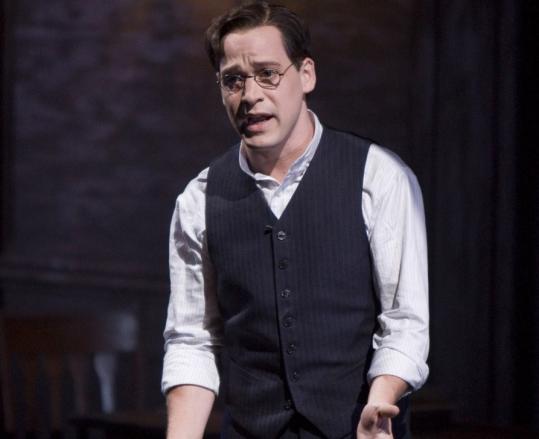
Parade is a re-telling of the story of Leo Frank (played by Knight), a Brooklyn Jew living in Atlanta, Georgia, who was convicted of the rape and murder of a 13 year-old girl. The show begins with a brief prologue of a young Confederate soldier leaving to fight for his home land and the southern ideals he believes in -- the prologue quickly segues into post-Civil War Atlanta on Confederate Memorial Day, where it becomes immediately apparent that the pride and love that the townsfolk felt for the south is as strong as it was when they went to war half a century before. Early on, Leo is accused, and the people of Atlanta immediately rally against the Yankee outsider; it is as if they are fighting the war again, determined this time to maintain the purity of the south by destroying a man they see as a filthy, murdering Yankee outsider. Leo's already shaky relationship with his wife, Lucille, is strained even more by his jailing and his upcoming trial. Act I ends with Frank's sentence, and Act II picks up a year later, with Leo in the midst of fighting his sentence. As support for a re-trial springs from the north, Lucille is finally able to convince Georgia's governor to reopen the case. Leo finally begins to see Lucille for what she's worth, instead of the hindrance he always imagined her to be, and as the governor and Lucille uncover the misconduct used by the prosecuting attorney, his love for for his wife grows. In another year, Lucille visits Leo in jail with a picnic dinner, and for the first time in their marriage, he is able to tell Lucille that he loves her -- a moment that was absolutely beautiful in this production.
Parade almost plays as two conflicting stories, that of Leo and Lucille, and that of the southerners who fight to see Leo hanged. We meet a great deal of characters who all push their own agenda on the case -- Governor Slaton, who is looking to wrap up the messy murder as quickly and quietly as possible; Prosecuting Attorney Hugh Dorsey, who wants to make a statement by hanging a white northerner; Reporter Britt Craig, who wants to stir up a media frenzy so he can have something exciting to write about; Christian extremist Tom Watson, who wants to see the Jew defeated; and Frankie Epps, teenage friend of the murdered girl, who seeks vengeance for the inexplicable loss of his friend. As these agendas converge with the greater disgust that the town feels about the blemish on their beautiful city, a mob frenzy is created, pushing in on Leo and Lucille. However, it is this very crush that push Leo and Lucille closer together -- in the midst of tragedy, their love is ignited.
This production was lacking in the aforementioned second story. Right off the bat, the prologue was not played in a way that really established that the people of Atlanta shared a love for their home land; passion and southern pride were overlooked for pretty singing and confusing blocking, that had the young soldier on his way to battle wandering all over the stage unspecifically. As Act I progressed, I noticed a great deal of cuts from the original script -- whole songs, introductions of characters -- that deterred from the audience's understanding of these southern characters as people instead of just caricatures of ignorant southerners. At the end of Act I, my friend, who is originally from Florida, turned to me and said, "Maybe some people find this interesting, this portrayal of southerners as evil, but I just find it insulting."
Act II is where the production really started to work, mostly because Leo and Lucille's relationship really began to come to the forefront. Knight's transformation from workaholic, disconnected husband to loving, caring partner worked especially well. In his first moments on stage, he immediately established his disinterest in his wife through his sharp, terse manner of speaking, his rigid physicality, and the way he carried himself in scenes with Lucille -- he rarely stayed still when with her, and when he did, he was always focused on something other than her -- fixing his tie, or picking up a hairpin. All this work paid off in Act II, when he was able to gradually drop the work, as it were. Physically, he loosened up, he began to give her all his attention when they spoke, and in the picnic scene, he spoke to Lucille in a manner reminiscent of a first date, when both partners are giddy, nervous, but so excited just to share a moment with the one they love. We left the theater that night brimming with excitement and joy about the beauty of love sparked in the midst of a tragic event -- even though the tragic event was undercooked.
This was a flawed production, in many ways -- script cuts and performances fell far short of creating the necessary southern pride that would allow the audience to see the southerners as people with wants and desires instead of simply The Enemy. But Knight's performance was absolutely magnificent, and it beautifully embodied the transformation of Leo Frank from shy and business-minded to adoring husband -- and that is what is at the heart of the play anyways. Sometimes it takes tragedy in order for beauty to flourish.
I'll leave you with the song "The Old Red Hills of Home" from the London Cast Recording. This is the first number in the show, and it masterfully establishes the pride and love that the people of Georgia feel for their home. I believe it to be one of the greatest musical theatre songs ever written.

