Visual artists create their pieces from scratch and choose their subject matter. Songwriters write their own songs, writers their own words. Photographers are blessed to be able to point their camera at anything they want. But actors are one of the few breeds of artists that build off of someone else's creation. How then, when I move from script to script, director to director, do I summarize my work? I spent some time considering this question. And by "some time", I mean roughly five seconds. The answer hit me pretty suddenly.
Unity. Stories that unite audiences in a common goal or idea, that bring them together through laughter, or simply those that remind the audience that no one struggles through life alone.
I have a lot of hate in my heart. People, places, technological snafus fill me with contempt, but my acting is always joyous. It's the one chance I have to share with everyone and anyone in the audience -- and in the play -- a sort of weighted optimism, a belief that this existence is good once you dig through all the bullshit. And whether the outcome of the play is lightheartedly silly, or bittersweet, or downright tragic, the fact that we share it together is beautiful.
Sunday, November 22, 2009

Sunday, November 1, 2009
Blog Post 3: Parade
Ladies and gentlemen, I stand before you -- or sit before you, that would be more appropriate -- doesn't matter -- a very happy theatre patron.
CTG's production of Parade, running now at the Mark Taper Forum, was a fantastic piece of theatre. And I'm extremely happy that most of what made this production amazing was Mr. TR Knight, the X Factor that had initially scared me off the production.

Parade is a re-telling of the story of Leo Frank (played by Knight), a Brooklyn Jew living in Atlanta, Georgia, who was convicted of the rape and murder of a 13 year-old girl. The show begins with a brief prologue of a young Confederate soldier leaving to fight for his home land and the southern ideals he believes in -- the prologue quickly segues into post-Civil War Atlanta on Confederate Memorial Day, where it becomes immediately apparent that the pride and love that the townsfolk felt for the south is as strong as it was when they went to war half a century before. Early on, Leo is accused, and the people of Atlanta immediately rally against the Yankee outsider; it is as if they are fighting the war again, determined this time to maintain the purity of the south by destroying a man they see as a filthy, murdering Yankee outsider. Leo's already shaky relationship with his wife, Lucille, is strained even more by his jailing and his upcoming trial. Act I ends with Frank's sentence, and Act II picks up a year later, with Leo in the midst of fighting his sentence. As support for a re-trial springs from the north, Lucille is finally able to convince Georgia's governor to reopen the case. Leo finally begins to see Lucille for what she's worth, instead of the hindrance he always imagined her to be, and as the governor and Lucille uncover the misconduct used by the prosecuting attorney, his love for for his wife grows. In another year, Lucille visits Leo in jail with a picnic dinner, and for the first time in their marriage, he is able to tell Lucille that he loves her -- a moment that was absolutely beautiful in this production.
Parade almost plays as two conflicting stories, that of Leo and Lucille, and that of the southerners who fight to see Leo hanged. We meet a great deal of characters who all push their own agenda on the case -- Governor Slaton, who is looking to wrap up the messy murder as quickly and quietly as possible; Prosecuting Attorney Hugh Dorsey, who wants to make a statement by hanging a white northerner; Reporter Britt Craig, who wants to stir up a media frenzy so he can have something exciting to write about; Christian extremist Tom Watson, who wants to see the Jew defeated; and Frankie Epps, teenage friend of the murdered girl, who seeks vengeance for the inexplicable loss of his friend. As these agendas converge with the greater disgust that the town feels about the blemish on their beautiful city, a mob frenzy is created, pushing in on Leo and Lucille. However, it is this very crush that push Leo and Lucille closer together -- in the midst of tragedy, their love is ignited.
This production was lacking in the aforementioned second story. Right off the bat, the prologue was not played in a way that really established that the people of Atlanta shared a love for their home land; passion and southern pride were overlooked for pretty singing and confusing blocking, that had the young soldier on his way to battle wandering all over the stage unspecifically. As Act I progressed, I noticed a great deal of cuts from the original script -- whole songs, introductions of characters -- that deterred from the audience's understanding of these southern characters as people instead of just caricatures of ignorant southerners. At the end of Act I, my friend, who is originally from Florida, turned to me and said, "Maybe some people find this interesting, this portrayal of southerners as evil, but I just find it insulting."
Act II is where the production really started to work, mostly because Leo and Lucille's relationship really began to come to the forefront. Knight's transformation from workaholic, disconnected husband to loving, caring partner worked especially well. In his first moments on stage, he immediately established his disinterest in his wife through his sharp, terse manner of speaking, his rigid physicality, and the way he carried himself in scenes with Lucille -- he rarely stayed still when with her, and when he did, he was always focused on something other than her -- fixing his tie, or picking up a hairpin. All this work paid off in Act II, when he was able to gradually drop the work, as it were. Physically, he loosened up, he began to give her all his attention when they spoke, and in the picnic scene, he spoke to Lucille in a manner reminiscent of a first date, when both partners are giddy, nervous, but so excited just to share a moment with the one they love. We left the theater that night brimming with excitement and joy about the beauty of love sparked in the midst of a tragic event -- even though the tragic event was undercooked.
This was a flawed production, in many ways -- script cuts and performances fell far short of creating the necessary southern pride that would allow the audience to see the southerners as people with wants and desires instead of simply The Enemy. But Knight's performance was absolutely magnificent, and it beautifully embodied the transformation of Leo Frank from shy and business-minded to adoring husband -- and that is what is at the heart of the play anyways. Sometimes it takes tragedy in order for beauty to flourish.
I'll leave you with the song "The Old Red Hills of Home" from the London Cast Recording. This is the first number in the show, and it masterfully establishes the pride and love that the people of Georgia feel for their home. I believe it to be one of the greatest musical theatre songs ever written.
CTG's production of Parade, running now at the Mark Taper Forum, was a fantastic piece of theatre. And I'm extremely happy that most of what made this production amazing was Mr. TR Knight, the X Factor that had initially scared me off the production.
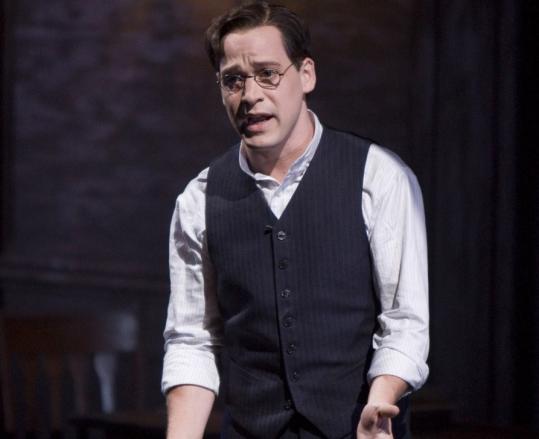
Parade is a re-telling of the story of Leo Frank (played by Knight), a Brooklyn Jew living in Atlanta, Georgia, who was convicted of the rape and murder of a 13 year-old girl. The show begins with a brief prologue of a young Confederate soldier leaving to fight for his home land and the southern ideals he believes in -- the prologue quickly segues into post-Civil War Atlanta on Confederate Memorial Day, where it becomes immediately apparent that the pride and love that the townsfolk felt for the south is as strong as it was when they went to war half a century before. Early on, Leo is accused, and the people of Atlanta immediately rally against the Yankee outsider; it is as if they are fighting the war again, determined this time to maintain the purity of the south by destroying a man they see as a filthy, murdering Yankee outsider. Leo's already shaky relationship with his wife, Lucille, is strained even more by his jailing and his upcoming trial. Act I ends with Frank's sentence, and Act II picks up a year later, with Leo in the midst of fighting his sentence. As support for a re-trial springs from the north, Lucille is finally able to convince Georgia's governor to reopen the case. Leo finally begins to see Lucille for what she's worth, instead of the hindrance he always imagined her to be, and as the governor and Lucille uncover the misconduct used by the prosecuting attorney, his love for for his wife grows. In another year, Lucille visits Leo in jail with a picnic dinner, and for the first time in their marriage, he is able to tell Lucille that he loves her -- a moment that was absolutely beautiful in this production.
Parade almost plays as two conflicting stories, that of Leo and Lucille, and that of the southerners who fight to see Leo hanged. We meet a great deal of characters who all push their own agenda on the case -- Governor Slaton, who is looking to wrap up the messy murder as quickly and quietly as possible; Prosecuting Attorney Hugh Dorsey, who wants to make a statement by hanging a white northerner; Reporter Britt Craig, who wants to stir up a media frenzy so he can have something exciting to write about; Christian extremist Tom Watson, who wants to see the Jew defeated; and Frankie Epps, teenage friend of the murdered girl, who seeks vengeance for the inexplicable loss of his friend. As these agendas converge with the greater disgust that the town feels about the blemish on their beautiful city, a mob frenzy is created, pushing in on Leo and Lucille. However, it is this very crush that push Leo and Lucille closer together -- in the midst of tragedy, their love is ignited.
This production was lacking in the aforementioned second story. Right off the bat, the prologue was not played in a way that really established that the people of Atlanta shared a love for their home land; passion and southern pride were overlooked for pretty singing and confusing blocking, that had the young soldier on his way to battle wandering all over the stage unspecifically. As Act I progressed, I noticed a great deal of cuts from the original script -- whole songs, introductions of characters -- that deterred from the audience's understanding of these southern characters as people instead of just caricatures of ignorant southerners. At the end of Act I, my friend, who is originally from Florida, turned to me and said, "Maybe some people find this interesting, this portrayal of southerners as evil, but I just find it insulting."
Act II is where the production really started to work, mostly because Leo and Lucille's relationship really began to come to the forefront. Knight's transformation from workaholic, disconnected husband to loving, caring partner worked especially well. In his first moments on stage, he immediately established his disinterest in his wife through his sharp, terse manner of speaking, his rigid physicality, and the way he carried himself in scenes with Lucille -- he rarely stayed still when with her, and when he did, he was always focused on something other than her -- fixing his tie, or picking up a hairpin. All this work paid off in Act II, when he was able to gradually drop the work, as it were. Physically, he loosened up, he began to give her all his attention when they spoke, and in the picnic scene, he spoke to Lucille in a manner reminiscent of a first date, when both partners are giddy, nervous, but so excited just to share a moment with the one they love. We left the theater that night brimming with excitement and joy about the beauty of love sparked in the midst of a tragic event -- even though the tragic event was undercooked.
This was a flawed production, in many ways -- script cuts and performances fell far short of creating the necessary southern pride that would allow the audience to see the southerners as people with wants and desires instead of simply The Enemy. But Knight's performance was absolutely magnificent, and it beautifully embodied the transformation of Leo Frank from shy and business-minded to adoring husband -- and that is what is at the heart of the play anyways. Sometimes it takes tragedy in order for beauty to flourish.
I'll leave you with the song "The Old Red Hills of Home" from the London Cast Recording. This is the first number in the show, and it masterfully establishes the pride and love that the people of Georgia feel for their home. I believe it to be one of the greatest musical theatre songs ever written.
Friday, October 23, 2009
Prelude to a Post

Tonight, I am going to see Parade.
Parade is a musical, book written by Alfred Uhry and music and lyrics by Jason Robert Brown. It opened on Broadway in 1998, and despite being nominated for and winning multiple Tony Awards, including a nomination for Best Musical and wins for Best Book of a Musical and Best Original Musical Score, it ran for only 85 performances -- a far cry from a successful Broadway run. Compare 85
performances to the Broadway run of Cats, which ran for almost 18 years and gave 7485 performances in total.
I'm not trying to knock Cats here -- there is a time and place for everything, including boppy, synthy musicals full of prancing felines -- but I don't think you could make a very strong argument that Cats offers something really substantial to its audience beyond a fun time. Apart from its absolutely beautiful music, Parade offers a re-telling of an unknown historic event, an extremely colorful cast of characters all pushing their own agendas, and -- most importantly -- a powerful story of conflicting passions, redemption, and finding love in the darkest of situations. And yet, audiences weren't enthused enough to warrant the production giving more than 85 performances. It was as if they were saying, "Don't challenge us. We didn't come here for a message of love and redemption against the odds. We came here for a musical."
And now, 10 years later, Parade is coming to Los Angeles for the only the second time, and the first time it is being produced by a major theater company (Center Theatre Group). In the decade since it was originally produced, Jason Robert Brown, the composer, has made a huge name for himself in the theatre world, and the show has created a lot of hype. Center Theatre Group has finally taken it upon themselves to bring this show to Los Angeles. And they've cast TR Knight, of Grey's Anatomy fame, in the lead role. This scares me. The inclusion of a big name TV actor in a musical gives me an impression that the producers don't have their heads in the right place. Is this an opportunity to share an incredibly moving and meaningful story, or is this an opportunity to make money via spectacle and celebrity appearances? Los Angeles audiences are getting excited about this production -- I just hope they're getting excited for the right reasons.
Center Theatre Group's production of Parade has a lot riding on its shoulders. It could seriously change the way that we look at musical theatre as a genre. The script of Parade alone proves that a musical can be so much more than charismatic performances and big ensemble numbers. It uses music to its advantage, creating an atmosphere that is so much more powerful and feverish in telling a story than a normal drama could do. I hope that this production tonight recognizes that. And I'm about to find out.
Friday, September 25, 2009
Blog Post 1: Brecht On Wedekind
In preparation for A Dream Play, which is opening next weekend (awkward pseudo self-promotion), I've been rereading some of Bertolt Brecht's writings on theatre. Brecht advocated a theatre that asked questions of its audience without providing answers, in hopes of forcing the audience to take action. While A Dream Play does not possess the same sociopolitical messages that Brecht's own plays did, it is full of characters who do take no action to better their lives. I've been committed to using Brecht's ideas to force the audience to leave the play with a desire to take the necessary steps to better themselves. If I can't give them that, what good is the play? An hour and a half is too long to watch a mope fest.
I began with my favorite of Brecht's essays, a short piece in which he writes about the passing of fellow German playwright, Frank Wedekind.

Haven't heard of him? You may be surprised to hear he is the man who made this possible (I'm sorry to hyperlink that image, but I couldn't allow the Littleworld to be associated with that show). About 100 years ago, Wedekind wrote the play that the musical Spring Awakening was based on. Because I've already gotten off topic enough, suffice it to say that I am not a big fan of the musical. Perhaps some day I'll write more thoroughly about this in the Littleworld.
What Brecht admired most about Wedekind was, simply, his vibrancy. He remarks on hearing Wedekind sing:
"A few weeks ago... he sang his songs to guitar accompaniment in a brittle voice, slightly monotonous and quite untrained. No singer ever gave me such a shock, such a thrill. It was the man's intense aliveness, the energy which allowed him to defy sniggering ridicule and proclaim his brazen hymn to humanity, that... gave him this personal magic."
Now, when it comes to acting, I'm a sucker for technique. I like to think that everything I do on stage has been thoroughly crafted and thought out before it's done. I spend far too much time sitting around, analyzing the script, poring over it until every single word makes sense. But what Brecht has hit on in Wedekind's work is that all the technique in the world -- all the planning and theorizing and deliberating -- will mean absolutely nothing without passion.
This applies to everything artistic. The best examples I can think of are in music: Metal guitarists like Yngwie Malmsteen have a technical guitar prowess is undeniable, but what lasting impact have they had on music? Have you even heard of Yngwie Malmsteen? By contrast, the great blues guitarists and singers of the 20th century, the men who laid the foundation for all rock music, played a few chords and piled their emotion into their music. They had skill, of course, but their energy, their personality, their attitudes, their joy and their sorrows were right there in the songs -- THAT'S what made it worth listening to. And that's why, though you may not have heard of names like Robert Johnson, Muddy Waters, Buddy Guy, Leadbelly, Son House, you have undoubtedly heard their impact if you listen to music written after the 50's.
Unless all you listen to is metal. Then you can suck it.
I can tell when an actor's not having fun on stage or on film. I am always baffled by this phenomenon. If you're not having fun... what are you doing? Show business (along with all other artistic endeavors) is far too fickle to be holding out hopes of fame and fortune if you're not having a good time. The thrill of creating is one that can never be taken from you by a director, record producer, casting agent, gallery owner, or critic. Hold on to it tightly.
I will leave you with a few links. First, young Buddy Guy. Tell me there isn't something delightfully captivating about his complete and utter immersion in his music.
Second, a Chuck Berry and John Lennon colloboration. Not the blues, but I smiled so much watching this video that I had to include it.
Finally, I think I will make a habit of including sound bites from things that I hold near and dear to my heart. Last post it was Animal House, this post it's Starfox 64: The most quotable video game ever. This website is extremely comprehensive. If you're a fan of the game, check it out.
And if you're not, then you can suck it.
I began with my favorite of Brecht's essays, a short piece in which he writes about the passing of fellow German playwright, Frank Wedekind.

Haven't heard of him? You may be surprised to hear he is the man who made this possible (I'm sorry to hyperlink that image, but I couldn't allow the Littleworld to be associated with that show). About 100 years ago, Wedekind wrote the play that the musical Spring Awakening was based on. Because I've already gotten off topic enough, suffice it to say that I am not a big fan of the musical. Perhaps some day I'll write more thoroughly about this in the Littleworld.

What Brecht admired most about Wedekind was, simply, his vibrancy. He remarks on hearing Wedekind sing:
"A few weeks ago... he sang his songs to guitar accompaniment in a brittle voice, slightly monotonous and quite untrained. No singer ever gave me such a shock, such a thrill. It was the man's intense aliveness, the energy which allowed him to defy sniggering ridicule and proclaim his brazen hymn to humanity, that... gave him this personal magic."
Now, when it comes to acting, I'm a sucker for technique. I like to think that everything I do on stage has been thoroughly crafted and thought out before it's done. I spend far too much time sitting around, analyzing the script, poring over it until every single word makes sense. But what Brecht has hit on in Wedekind's work is that all the technique in the world -- all the planning and theorizing and deliberating -- will mean absolutely nothing without passion.
This applies to everything artistic. The best examples I can think of are in music: Metal guitarists like Yngwie Malmsteen have a technical guitar prowess is undeniable, but what lasting impact have they had on music? Have you even heard of Yngwie Malmsteen? By contrast, the great blues guitarists and singers of the 20th century, the men who laid the foundation for all rock music, played a few chords and piled their emotion into their music. They had skill, of course, but their energy, their personality, their attitudes, their joy and their sorrows were right there in the songs -- THAT'S what made it worth listening to. And that's why, though you may not have heard of names like Robert Johnson, Muddy Waters, Buddy Guy, Leadbelly, Son House, you have undoubtedly heard their impact if you listen to music written after the 50's.
Unless all you listen to is metal. Then you can suck it.
I can tell when an actor's not having fun on stage or on film. I am always baffled by this phenomenon. If you're not having fun... what are you doing? Show business (along with all other artistic endeavors) is far too fickle to be holding out hopes of fame and fortune if you're not having a good time. The thrill of creating is one that can never be taken from you by a director, record producer, casting agent, gallery owner, or critic. Hold on to it tightly.
I will leave you with a few links. First, young Buddy Guy. Tell me there isn't something delightfully captivating about his complete and utter immersion in his music.
Second, a Chuck Berry and John Lennon colloboration. Not the blues, but I smiled so much watching this video that I had to include it.
Finally, I think I will make a habit of including sound bites from things that I hold near and dear to my heart. Last post it was Animal House, this post it's Starfox 64: The most quotable video game ever. This website is extremely comprehensive. If you're a fan of the game, check it out.
And if you're not, then you can suck it.
Thursday, September 17, 2009
My First Real Blog
I just made something beautiful from something terrible.
Skating home from campus, I came across a pile of shattered glass -- the last, lonely remnants of a car stolen or broken into. Though I immediately identified the glass's appearance as something to be lamented, I couldn't fight the urge to skate through it. Like a jumble of marbles in an old comedy, the shattered bits almost caused me to slide out and fall to the ground, but I managed to maintain my balance and ride away. Narrowly escaping certain doom is easily one of the best feelings in skateboarding, and this moment was a definite highlight of my day.
Unlike my acting, this was a moment exclusively for me, but it got me thinking about my current artistic project. I've been rehearsing for an on campus production of A Dream Play for two and half weeks, and with two and a half weeks left before we open, I'm feeling the pressure. I know that I have been neglecting my work for the piece, and I can boil down the reasons to the fact that I am completely unenthused by the material and I am working with some completely uninspiring people -- in a cast and production team of fantastic artists, they are the exception, but they still weigh heavily on my mind and soul.
I've been so busy looking at the tragedy that I am failing to see the beauty of my situation. I am extremely fortunate to be working on an immensely challenging and rewarding character, and I am acting alongside some of my best friends. Two and a half weeks isn't a very long time, but if I apply myself in the ways that I know I can, I can narrowly escape certain artistic doom and salvage my work. And this time, I'll be able to share it with an audience.
Welcome to the Littleworld! I stumbled across this gem of a website while writing this post. I suggest you take some time and check it out: Animal House Sound Clips
Skating home from campus, I came across a pile of shattered glass -- the last, lonely remnants of a car stolen or broken into. Though I immediately identified the glass's appearance as something to be lamented, I couldn't fight the urge to skate through it. Like a jumble of marbles in an old comedy, the shattered bits almost caused me to slide out and fall to the ground, but I managed to maintain my balance and ride away. Narrowly escaping certain doom is easily one of the best feelings in skateboarding, and this moment was a definite highlight of my day.
Unlike my acting, this was a moment exclusively for me, but it got me thinking about my current artistic project. I've been rehearsing for an on campus production of A Dream Play for two and half weeks, and with two and a half weeks left before we open, I'm feeling the pressure. I know that I have been neglecting my work for the piece, and I can boil down the reasons to the fact that I am completely unenthused by the material and I am working with some completely uninspiring people -- in a cast and production team of fantastic artists, they are the exception, but they still weigh heavily on my mind and soul.
I've been so busy looking at the tragedy that I am failing to see the beauty of my situation. I am extremely fortunate to be working on an immensely challenging and rewarding character, and I am acting alongside some of my best friends. Two and a half weeks isn't a very long time, but if I apply myself in the ways that I know I can, I can narrowly escape certain artistic doom and salvage my work. And this time, I'll be able to share it with an audience.
Welcome to the Littleworld! I stumbled across this gem of a website while writing this post. I suggest you take some time and check it out: Animal House Sound Clips
Subscribe to:
Posts (Atom)